
Best VPN for China 2026: Free & Paid Options That Actually Connect
VPNPower Editorial Team · Updated September 10, 2026
VPNs that stay working in China 👇
Set up in 2 minutes before you travel · Both come with a refund guarantee, zero risk to try
✓ No-logs policy · ✓ Alipay/WeChat Pay accepted (ZoogVPN) · ✓ Both have a free tier you can download first · ✓ Refund guarantee if unsatisfied

Recommended VPNs
ZoogVPN
The clear front-runner
ZoogVPN has stayed reliably online in mainland China for years, holding up even during politically sensitive periods. Its built-in obfuscation protocol balances getting through the firewall with security, and stays fast; it also includes streaming unblock and a kill switch. There's a real free tier — 10GB/month, 5 locations, 1 device — before you pay anything. Paid plans start at $2.49/month with a 7-day refund window, 10 simultaneous devices, and unlimited, unthrottled data.
Checked August 2026: official China plan page live, Shadow protocol on sale
Pros
- ✓Real free tier you can download and test first (10GB/month)
- ✓Cheap — long-term plans from $2.49/month
- ✓10 simultaneous devices on one account
- ✓Built-in obfuscation for mainland China, holds up well
- ✓Unlimited data, no throttling, includes streaming unblock
- ✓Full Linux command-line client
Cons
- ✕Fewer servers than the largest global brands
- ✕Refund window is only 7 days (NordVPN's is 30)
- ✕No published third-party audit of its no-logs policy
Free tier included (10GB/month · 5 locations · 1 device) · 7-day refund guarantee · 10 devices
AdGuard VPN
Simplest obfuscated option
AdGuard VPN comes from the well-known ad-blocking team at AdGuard. Its own protocol disguises VPN traffic as ordinary HTTPS/2 by default, so there's no manual "enable obfuscation" step some competitors require — it just works out of the box. As of 2026 the core protocol (TrustTunnel) is open-sourced, a real transparency plus. Covers 70+ regions, supports 10 devices, and has a genuine 3GB/month free tier to test with. Reasonably priced, with a 30-day refund on annual plans. Worth noting: the company hasn't officially guaranteed 100% stability during politically sensitive periods in China, so test the free tier or refund window before committing long-term.
2026: default obfuscation works for circumvention; stability depends on your network
Pros
- ✓Obfuscation on by default — nothing to configure
- ✓Core protocol is open-source (TrustTunnel), genuinely transparent
- ✓Supports 10 devices, includes a 3GB/month free tier
- ✓Competitively priced, 30-day refund on annual plans
- ✓Comes from an established, reputable ad-blocking company
Cons
- ✕No official guarantee of stability during sensitive periods in China
- ✕Doesn't accept Alipay or WeChat Pay
- ✕Fewer regions than the largest brands
Free tier included (3GB/month) · 30-day refund guarantee (annual/2-year plans) · 10 devices
If you’re reading this from inside China, or about to be, you already know the actual question isn’t “which VPN is best” in the abstract — it’s which one still connects here, today. This is a working list, kept current, of what’s actually reported as functional, what the real free-tier limits are, and what to do when a connection that used to work suddenly doesn’t.
Why “VPN” alone isn’t enough in China
Most VPN comparison content is written for people who just want privacy on public WiFi — for them, almost any VPN works fine. China is a different problem entirely: the Great Firewall actively fingerprints VPN traffic and blocks it, not just the destination sites. A VPN that’s excellent everywhere else can be completely unusable here if it doesn’t disguise its own traffic pattern.
The one factor that actually predicts whether a VPN works in China is obfuscation — whether the app disguises its traffic as ordinary encrypted web traffic (HTTPS) instead of looking like a VPN at all. Some brands build this in by default; with others, it’s a setting you have to find and turn on yourself, and it’s the single most common reason a “VPN that doesn’t work” turns out to just be misconfigured.
This isn’t an abstract inconvenience — the Great Firewall blocks entire categories of services outright, not just “slows” them: Google (Gmail, Drive, Scholar included), Facebook, Instagram, X/Twitter, WhatsApp, Telegram, YouTube, Netflix, and the official apps and websites for ChatGPT, Claude, and Gemini all fail to load at all without a working connection, not just load slowly.
Paid VPNs that report working in China
ZoogVPN — obfuscation on by default
Ships with its own obfuscation protocol (“Shadow”) switched on out of the box — no settings menu to dig through. 10 devices on one account, a full Linux client, and direct Alipay/WeChat Pay/UnionPay support, which matters if your payment card is Chinese-only. Starts at $2.49/month on a long-term plan, 7-day refund window. It also has a genuine free tier: 10GB/month, 1 device, 5 server locations, obfuscation included — enough to confirm your specific connection actually works before you pay for anything.
AdGuard VPN — obfuscated by default, simpler setup
From the team behind the AdGuard ad-blocker. Its own protocol (TrustTunnel, open-sourced in 2026) disguises traffic as regular HTTPS/2 by default, so there’s no manual “enable obfuscation” step. 10 devices, 75+ regions, from $3.99/month with a 30-day refund on annual plans. Free tier: 3GB/month, obfuscated. The company hasn’t publicly guaranteed 100% uptime during politically sensitive periods, so treat the free tier or refund window as your real-world test.
NordVPN — fastest, but obfuscation is manual
The largest server network here (6,400+ across 111 countries) and the fastest speeds once connected. The catch: you have to manually switch to an “Obfuscated Servers” option in the settings — it’s not on by default, and support threads are full of people who assumed it was. From $3.39/month, 30-day refund, no free tier.
ProtonVPN — real free tier, weaker in China specifically
Swiss-based, open-source, independently audited — genuinely strong on privacy. Its Stealth protocol is designed for censored networks and does work in China, but the free tier doesn’t include Stealth and only offers a handful of non-obfuscated servers, so the free version specifically tends not to connect reliably here. The paid tier (from $4.49/month) is a real option if privacy audits matter to you more than having the single most reliable China connection.
Astrill — long-time China specialist, no refund
A veteran choice among long-term China residents, running its own StealthVPN protocol built specifically for firewall evasion. Reliably stable in reports, but it’s one of the priciest options here (~$12.50/month) and offers no refund guarantee — no safety net if it turns out not to work for your specific setup.
ExpressVPN — easiest app, inconsistent lately
The simplest client to use, fast once connected, 105 countries covered. Its China reliability has been reported as inconsistent in recent months — solid for some users, not for others. Priced higher than most on this list (~$6.67/month), no free tier.
PureVPN — huge server count, obfuscation on every server
6,500+ servers across 65+ countries, with obfuscation enabled by default on every server rather than a toggle you have to find. Inexpensive (~$2/month). Reported China reliability is mixed — works for some connections, flaky for others — best treated as a budget backup rather than a primary option.
PrivateVPN — cheapest here, manual stealth mode
A small Swedish provider at one of the lowest prices on this list (~$2/month), with a manual Stealth mode that works in China once you switch it on. Fewer servers and average speeds at peak times, but a clean privacy record and support that will walk you through setup remotely if you get stuck.
VyprVPN — self-owned network, Chameleon protocol
Runs its own server infrastructure end-to-end (nothing rented from third parties) and built its own Chameleon protocol specifically to defeat deep packet inspection. China performance has reportedly improved in recent years. Speeds are mid-pack and pricing is on the higher side (~$5/month) — a fit for users who weight reliability and privacy over raw speed.
Surfshark — unlimited devices, Camouflage mode
The unlimited-devices option — one subscription covers every device in a household — at a low price (~$2.19/month). Its Camouflage mode enables obfuscation and does work in China, though reported stability is middling and you may need to try a few server locations. No Alipay or WeChat Pay — cards, PayPal, or crypto only.
Starting prices from each brand's own pricing page, long-term plan, monthly-equivalent. Promotions change often — check the checkout page for the current rate before buying. ZoogVPN checked 2026-08-23; others as last recorded.
A real speed reference: ZoogVPN’s own Hong Kong test
This is ZoogVPN’s own published speed-test screenshot, not a test we ran ourselves — treat it as a reference point, not a promise:
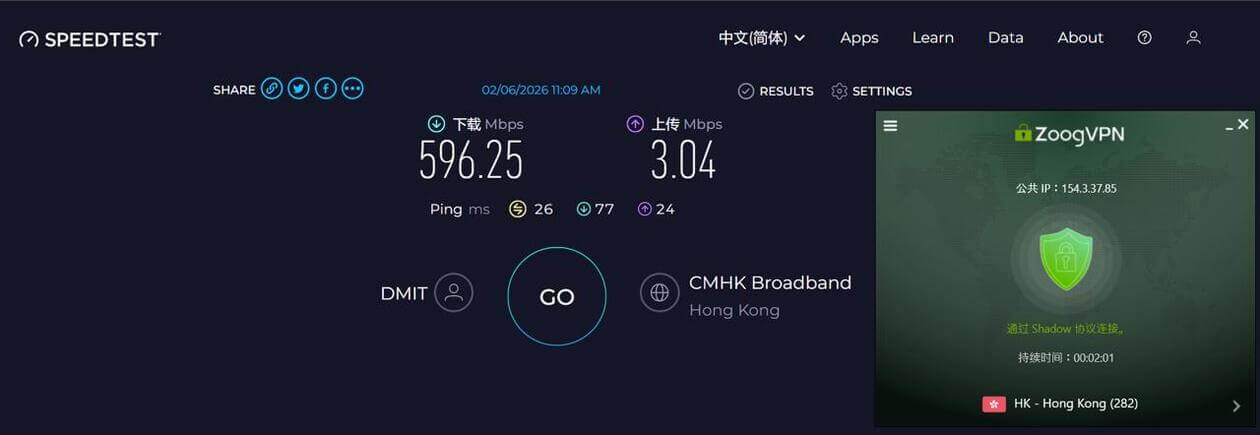
How to read this. 596 Mbps down and 26ms latency show that the obfuscation protocol itself isn’t the bottleneck on a well-provisioned line. It’s not a guarantee of your own speed — that depends on your local connection, which server you pick, and time-of-day congestion. Full breakdown in the ZoogVPN review.
Free VPN options: the real limits
| Free tier | Data / month | Devices | Locations | Obfuscation | Biggest catch |
|---|---|---|---|---|---|
| ZoogVPN Free | 10 GB | 1 | 5 | Yes (Shadow) | Fine for testing, not enough for daily video |
| AdGuard VPN Free | 3 GB | 2 | Limited | Yes, on by default | 3GB disappears fast if you stream anything |
| ProtonVPN Free | Unlimited | 1 | Few, random | No | No obfuscation — the thing that actually matters here |
Verified against each brand's own site, 2026-09-10. Free-tier terms change more often than paid plans — confirm on the provider's site before relying on a number here.
None of these are meant to replace a paid plan long-term — think of the free tier as a way to answer one specific question: does this actually connect from where I am, right now. If it does, and you need it daily, the paid tier removes the data cap and (for ZoogVPN/AdGuard) keeps the same obfuscation that made the free tier work in the first place.
Setting up before you land vs. after
If there’s one piece of advice that matters more than which brand you pick: get the app downloaded and your account set up before you arrive, if you can. Provider websites and app store listings are themselves inconsistently reachable from inside China, and account signup usually needs a working international payment method — both of those are a five-minute task on a normal connection and a genuine headache once you’re already offline.
If you’re already in China and starting from scratch: try the free tiers above first via each provider’s own site (not a third-party download mirror — modified installers are a real risk, since a VPN app has system-level network access). If one connects, you’ve confirmed your network can reach that provider at all, which is most of the battle.
Is there a permanently free VPN for China?
Not one that’s actually unlimited. Running servers and staying ahead of firewall detection are ongoing, real costs — a “free forever, no limits” VPN has to fund that from somewhere, and if it’s not from paying customers, it’s usually from your data. The free tiers above are real and safe specifically because they’re funded by the same company’s paying customers, not by you being the product — which is also exactly why they’re capped.
Bottom line
For most people arriving in or already living in China, ZoogVPN is the most consistently reported-working option because obfuscation is on by default and you’re not left guessing at a settings menu. If your priority is raw speed over ease of setup, NordVPN is faster once you’ve manually switched on its obfuscated servers. Either way: test the free tier or use the refund window to confirm it works for your specific network before assuming any one VPN is a permanent solution — connectivity here changes, and what worked for someone else last month isn’t a guarantee for you today.
Chinese version of this guide: 2026 中国 VPN 排行榜.
Quick VPN Comparison
| VPN | Works in China | Price | Devices | Rating | |
|---|---|---|---|---|---|
| ✓ Reliably works | $2.49/mo | 10 devices | ★ 5.0 | Download → | |
| ✓ Works (obfuscated by default) | $3.99/mo | 10 devices | ★ 4.8 | Download → | |
| ✓ Works (manual obfuscation) | $3.39/mo | 10 devices | ★ 4.8 | Read Review → | |
| ✓ Works (Stealth protocol) | $4.49/mo | 10 devices | ★ 4.6 | Read Review → | |
| ✓ Works (inconsistent) | $6.67/mo | 8 devices | ★ 4.5 | Read Review → | |
| ✓ Reliably works | $12.5/mo | 5 devices | ★ 4.4 | Read Review → | |
| ✓ Works (manual Camouflage mode) | $2.19/mo | Unlimited devices | ★ 4.3 | Read Review → | |
| ✓ Reliably works (Chameleon) | $5/mo | 10 devices | ★ 4.3 | Read Review → | |
| ST StrongVPN | ✓ Works | $4.50/mo | 5-12 devices (plan-dependent) | ★ 4.3 | Read Review → |
| PU PureVPN | ✓ Works (automatic obfuscation) | $2/mo | 10 devices | ★ 4.2 | Read Review → |
| ✓ Works (Stealth) | $2/mo | 10 devices | ★ 4.2 | Read Review → | |
| LE LetsVPN | ✓ Works (occasional connection reports in some regions since summer 2026) | $2.21/mo | Device count not published | ★ 4.0 | Read Review → |
| FL Flow VPN | ✓ Works, less stable than top-tier brands | $1.88/mo | Unlimited devices | ★ 3.8 | Read Review → |


Starting prices are each brand's own long-term-plan monthly average, and change with promotions — check the checkout page for the current rate before buying. ZoogVPN checked 2026-08-23 (USD from its official China plan page, CNY from its Chinese pricing page); other brands reflect the price on file as of their last review, not necessarily this moment's live rate.
Frequently Asked Questions
Does a normal VPN even work in China?+
Should I set up a VPN before I arrive in China, or can I do it after?+
Is there a genuinely free VPN that works in China?+
Why does a VPN that works for my friend not work for me?+
Do these VPNs accept Chinese payment methods?+
Further Reading
Disclosure: some links on this site are affiliate links — if you buy through one, we may earn a commission at no extra cost to you, and it doesn't influence our independent reviews. See our affiliate disclosure.